Bank Strikes in India: Why Do They Happen and How Do They Affect You?
A clear, simple guide to understanding the reasons behind bank strikes, the people involved, and how to keep your money moving without hassle. Have you ever walked up…
A clear, simple guide to understanding the reasons behind bank strikes, the people involved, and how to keep your money moving without hassle.
Have you ever walked up to your local bank branch on a weekday, only to find the metal shutters pulled down and placards hung outside? Or perhaps you received an SMS from your bank warning that branches will remain shut for the next two or three days due to a nationwide union strike.
For most of us, our immediate reaction is frustration. Cheques get delayed, cash deposits wait, and important branch paperwork comes to a sudden halt. But have you ever paused to wonder: Why do bank strikes happen so often in India? What are bank staff fighting for, and is there a side to the story we usually miss?
In this blog, we break down everything you need to know about bank strikes in India in simple, jargon-free language—from the key issues triggering the protests to practical steps you can take to keep your financial life uninterrupted.
Image source: https://www.outlookmoney.com/banking/bank-strike-september-28-30-5-things-customers-should-do-before-branches-close
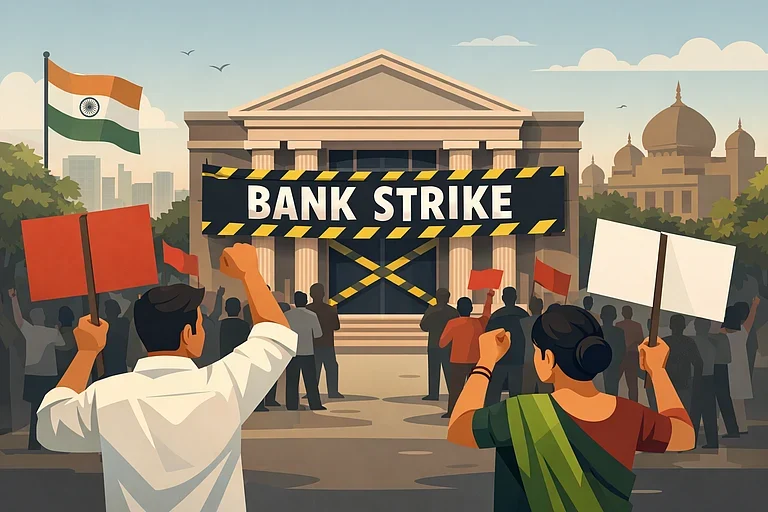
| Key Fact: Most bank strikes in India are organized by public sector bank unions representing hundreds of thousands of officers and clerks. While in-branch counters remain closed, critical digital services like UPI, mobile banking apps, and most ATMs usually stay online. |
1. Who Decides to Go on Strike?
Bank strikes in India do not happen randomly. They are carefully planned and coordinated by employee unions. The largest umbrella organization in Indian banking is called the United Forum of Bank Unions (UFBU).
UFBU represents over 90% of the public sector banking workforce. It brings together several major national unions that look after both junior clerical staff and senior bank officers. Some of the well-known member unions include:
- AIBEA: All India Bank Employees’ Association (the oldest and largest clerical union).
- AIBOC: All India Bank Officers’ Confederation (representing management officers and branch managers).
- NCBE: National Confederation of Bank Employees.
- Other specialized groups: Covering regional rural banks (RRBs), officers’ congresses, and specialized banking staff.
These unions regularly hold negotiations with the Indian Banks’ Association (IBA)—which represents bank managements—and officials from the Ministry of Finance. When prolonged talks fail to reach an agreement, unions use strikes as a peaceful constitutional tool to draw national attention to their demands.
2. The Big Demands: Why Are Bank Employees Striking?
It is easy to assume that bank employees are just asking for more holidays or higher pay. But if you take a closer look, many of their demands stem from real work pressures, changes in lifestyle, and promises that have remained pending for years. Here are the main issues driving recent strikes:
A. The Long-Pending Demand for a 5-Day Work Week
Currently, Indian bank employees work on alternate Saturdays. That means they only get holidays on the 2nd and 4th Saturdays of every month, while the 1st, 3rd, and 5th Saturdays are full working days.
Unions argue that almost all key economic institutions in India—including the Reserve Bank of India (RBI), the stock markets (BSE and NSE), insurance firms (like LIC), and central government offices—already follow a strict 5-day work week. Furthermore, bank staff have formally agreed to work 40 to 45 minutes extra every day from Monday to Friday to make up for Saturday hours so that total customer service time does not decrease. While bank managements agreed in principle during past settlements, the final official clearance from the central government has remained delayed, leading to widespread employee unrest.
B. Massive Workload and Heavy Staff Shortages
Over the last decade, Indian banks have undergone a massive transformation. Public sector bank staff have opened hundreds of millions of Jan Dhan accounts, distributed government social welfare subsidies, processed housing and agricultural loans, and managed intense compliance checks.
However, recruitments have not kept pace with retirements. In thousands of branches across India, a single officer or clerk is now doing the work that earlier required three people. The resulting stress and lack of work-life balance is a major reason why employees are pushing hard for institutional support.
C. Updating Pensions for Elderly Retirees
This is an emotional and deeply human issue. While active bank employees receive regular pay revisions every five years, the basic pension for past retirees has remained frozen based on pay scales from 20 or 30 years ago. A retired branch manager from the 1990s might receive a fraction of the pension drawn by a recent retiree, despite facing the exact same high cost of living today. Unions are demanding regular pension updates and a fair, uniform Dearness Allowance (DA) formula for all senior citizens.
D. Opposition to the Privatization of Public Sector Banks
Whenever the government discusses privatizing state-owned banks, unions strongly oppose it. Their argument is twofold: first, they want to protect job security and service conditions. Second, and equally important, they argue that public sector banks serve rural villages, farmers, and lower-income families where private banks often hesitate to open full-scale physical branches.
3. How Does a Bank Strike Affect Ordinary Citizens?
While employees have valid grievances, a bank strike inevitably creates speed bumps for ordinary citizens, small shopkeepers, and local businesses. Here is where the real-world impact is felt most:
| Service Category | What Happens During Strike? | Severity for Public |
| Cheque Clearing | Cheque drop boxes will not be processed. Clearing houses run with skeletal staff or remain paused. | High (Businesses & EMIs) |
| Cash Deposit / Withdrawal at Branch | Physical counters are shut. Senior citizens unable to use ATMs face immediate delays. | Medium to High |
| ATM Cash Availability | ATMs stocked before the strike will work, but high-demand neighborhood ATMs may run dry in 2-3 days. | Moderate |
| Loan Approvals & Paperwork | Branch documentation, mortgage clearances, and gold loan releases are put on hold. | Low to Moderate |
4. The Good News: What Still Works Seamlessly?
Twenty years ago, a bank strike brought economic life in India to a dead stop. If the bank branch was shut, you simply could not buy groceries, pay fees, or transfer money. Fortunately, India’s world-leading digital payment infrastructure has changed everything.
Even when bank shutters are firmly locked, these services continue to operate smoothly:
- UPI Payments (Google Pay, PhonePe, Paytm, BHIM): Instant money transfers to vendors, friends, and utility bills run without any interruption because UPI backend switches operate automatically 24×7.
- Mobile Banking & Net Banking: You can check balances, download account statements, set up recurring deposits, and make IMPS or NEFT transfers straight from your phone.
- Automated ATMs and Cash Recyclers: Most off-site and stand-alone bank kiosks are managed by independent cash-replenishment agencies, allowing you to withdraw or deposit cash at automated machines.
- Card Swipes & Online Purchases: Debit and credit card transactions on e-commerce websites and retail PoS terminals function completely normally.
5. Smart Tips: How to Protect Yourself During a Strike Alert
When news channels start flashing headlines about an upcoming bank strike, do not panic. A little bit of advance planning ensures your personal finances remain completely smooth:
- Withdraw Emergency Cash in Advance: If the strike coincides with a weekend (creating a 3 or 4-day closure), neighborhood ATMs can occasionally run out of cash. Keep enough cash at home for household groceries and emergency medical needs.
- Submit Cheques 2 to 3 Days Early: If you have an EMI, credit card payment, or house rent cheque scheduled, clear it well before the strike window to avoid bounce penalties or late fees.
- Rely on Digital Payment Modes: Keep your UPI PIN active and mobile banking app updated. Almost 90% of routine retail banking needs can be completed via your smartphone.
- Check With Private Banks: Major private lenders (like HDFC Bank, ICICI Bank, and Axis Bank) typically do not participate in nationwide UFBU strikes. While their branch staff may work normally, remember that inter-bank cheque clearance with public banks may still experience minor delays.
- Read Official Bank SMS Messages: Banks are legally required to notify customers in advance about scheduled disruptions and provide contact numbers for emergency customer care support.
6. Finding Common Ground: What Is the Way Forward?
A healthy banking system is the backbone of any growing nation. On one hand, millions of customers—especially senior citizens, farmers, and micro-traders—depend heavily on human touch and branch assistance for their day-to-day survival.
On the other hand, bank employees perform essential, high-pressure duties under tight regulatory scrutiny. Ensuring fair working hours, adequate branch staffing, and realistic pensions is not a luxury; it is vital for maintaining the mental well-being and productivity of the people who safeguard our hard-earned savings.
As digital banking continues to take over routine administrative tasks, transitioning to a structured 5-day week and modernizing human resource policies is both logical and achievable. Finding a balanced solution through timely dialogue between the government, the Indian Banks’ Association, and union leaders will ensure that employees get the dignity they deserve while the Indian economy keeps marching forward without a hitch.
| We’d Love to Hear From You! Have you ever experienced difficulty during a bank strike? Or do you support the demand for a 5-day banking week? Share your thoughts and personal experiences in the comments section below! |